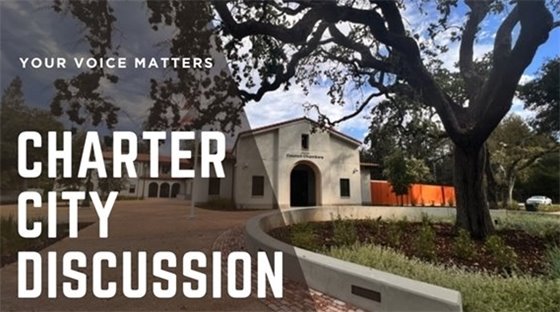
On January 29, the Town conducted a Kick-Off Public Workshop to provide an informational overview of the distinction between General Law Cities and Charter Cities. There is another workshop scheduled for February 26 at 6 pm at City Hall in the Council Chambers. This Workshop will be a general continuation of the discussion. If you attended the January 29 Workshop, the February 26 Workshop will be the same, but it will be another opportunity to continue the discussion with those attending.
The January 29 Kick-Off Workshop session was educational and exploratory in nature. The presentation focused on local control in the context of increasing state preemption. Staff explained that charter authority is limited to “municipal affairs” and does not override state housing laws, including RHNA, density bonus law, or other state mandates.
Charter authority applies only in specific areas defined through case law and depends on the language adopted in a charter. Common areas include certain governance structures, contracting practices, procurement rules, and local taxation procedures.
Staff clarified that many public works projects remain subject to state prevailing wage laws regardless of charter status. Charter adoption should not be viewed as a means to avoid prevailing wage requirements, which are largely governed by state law and depend on project type and funding.
Taxation generated significant discussion. Staff explained that charter status does not create new taxing authority or eliminate voter approval requirements, but a charter could allow different voter thresholds for municipal taxes if explicitly included and approved by voters. Staff acknowledged concerns raised by attendees and emphasized that any such provision would be a transparent policy choice subject to voter approval.
The presentation also outlined the typical charter consideration process, including legal drafting, public input, and voter consideration at an election. No charter provisions would take effect without voter approval.
Overall, staff emphasized that the Town’s role is educational, not advocacy-based. Attendees were engaged and focused on the practical implications of charter authority, particularly taxation and voter protections, and expressed a clear expectation that voters remain the ultimate decision-makers.
For more information, feel free to reach out to City Manager, George Rodericks at grodericks@athertonca.gov.



 Share on Facebook
 Share on Twitter
 Share via Email
